At a glance
The study assessed the association of system-level changes with anesthetic emissions across NYC Health + Hospitals. Its central insight: emissions from nitrous oxide infrastructure may substantially exceed those from clinical delivery at an individual hospital.
Research question
What were the relative contributions of central N₂O pipeline deactivation, decision-support alerts, and secular practice trends to reductions in anesthetic greenhouse gas emissions?
Why it matters
Deactivating central N₂O supply can address leakage upstream of the patient while selected locations retain cylinder-based access. Behavioral interventions address a different part of the emissions pathway.
Methods & interventions
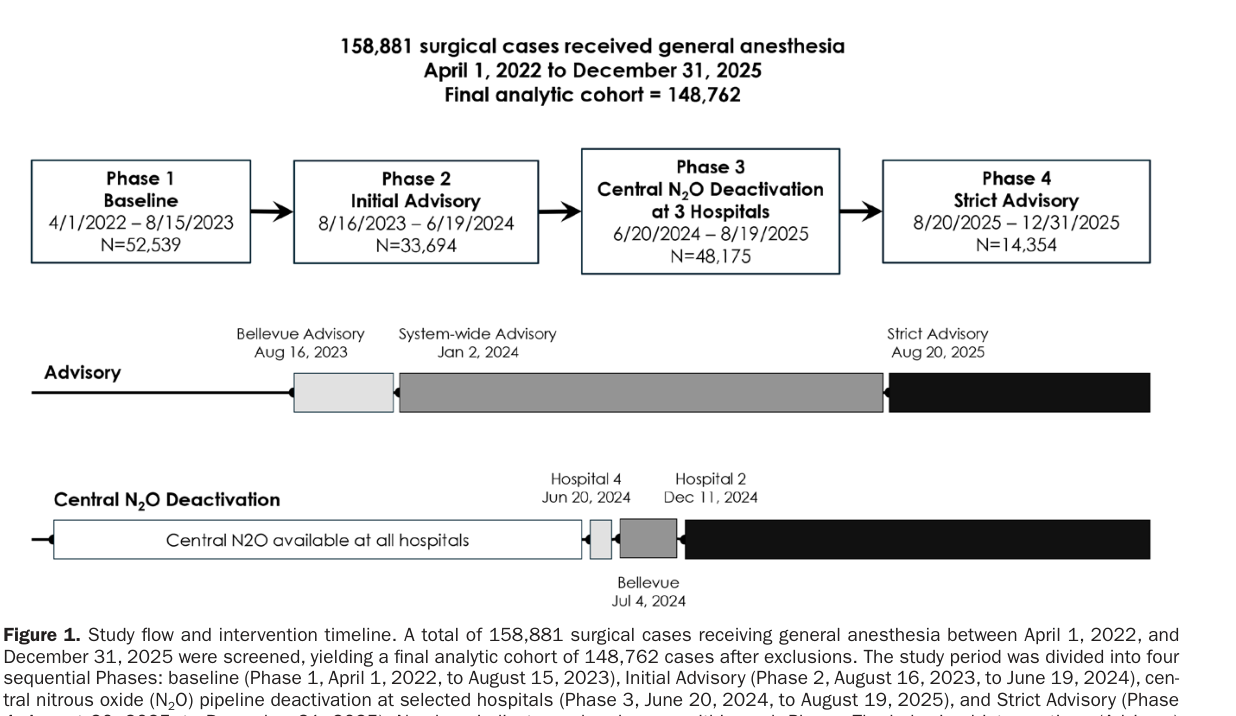
Interrupted time-series design
The study examined a staged clinical decision support advisory, staggered central N₂O pipeline deactivation, and broader practice changes.
Cylinder-based N₂O remained available in 37 of 73 anesthetizing locations (51%) at the three deactivation hospitals.
Figure 1 reproduced from Sutin et al., 2026, p. 4.
What was measured?
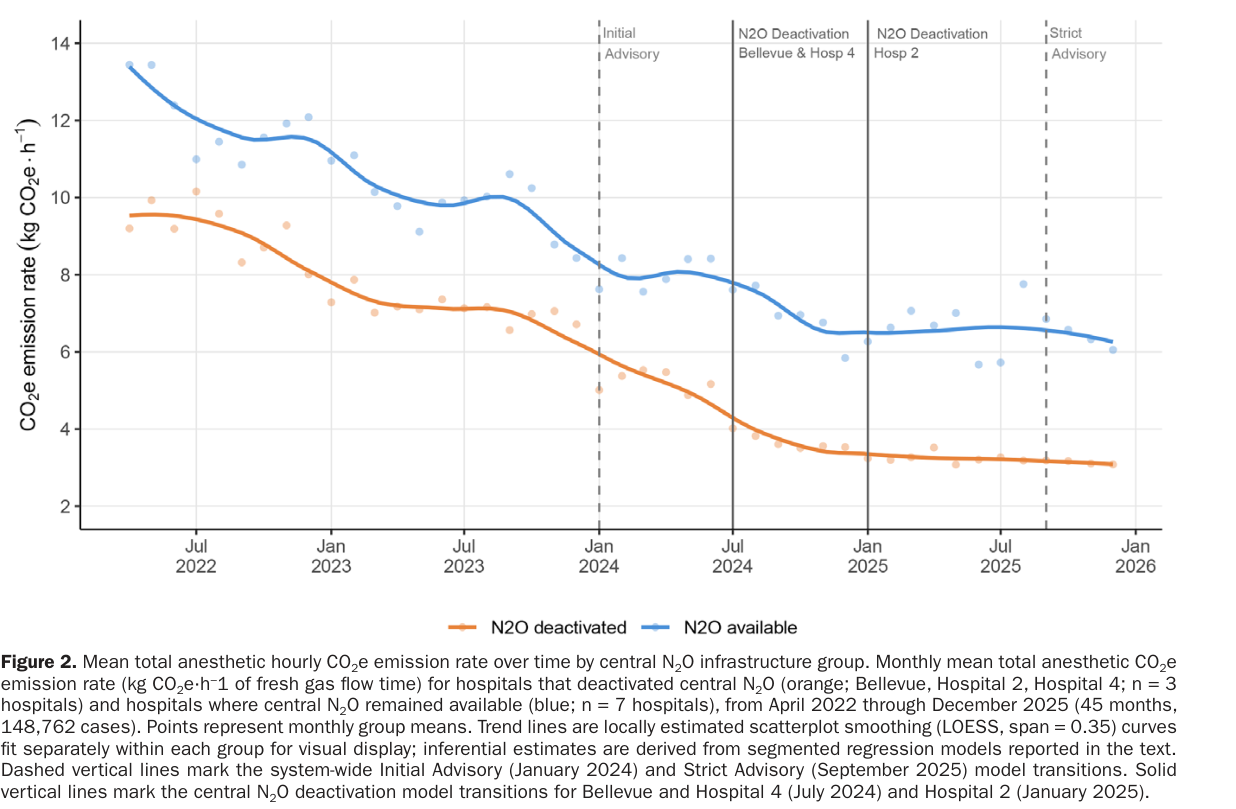
Case-level fresh gas flow, volatile and N₂O use, and derived emission rates expressed as kilograms CO₂-equivalent per hour of fresh gas flow time. Group-level monthly outcomes were analyzed using segmented regression.
Important exclusions
General anesthetics with total intravenous anesthesia alone, and missing or implausible data, were excluded. Outcomes therefore describe the analyzed inhalational anesthesia cases.
Compare the evidence
These outcomes are not interchangeable. Select an intervention to inspect its model, endpoint, and interpretation.
Baseline agent emissions
| Anesthetic | Cases using agent | Median hourly CO₂e rate when used | Annualized CO₂e impact |
|---|---|---|---|
| Sevoflurane | 97.8% | 3.7 kg/h | 361 metric tons/year |
| Nitrous oxide | 27.2% | 9.3 kg/h | 360 metric tons/year |
| Desflurane | 2.3% | 30.3 kg/h | 88 metric tons/year |
Values from the original baseline table, PDF page 6. Case percentages overlap in multiagent anesthetics. Annualized figures describe clinical gases, not upstream central pipeline losses.
Explore the published figures
These are cropped reproductions of figures from the supplied article PDF. Click an image to enlarge it; axes and data remain unchanged.
Research Spotlight video
Watch the narrated research summary, then use the tabs to examine the original methods, figures, and statistical caveats.
Video embed ready
Add a YouTube video ID or embed URL in index.html to display the finished Research Spotlight video here.
The original MP4 is not automatically bundled, to keep this website lightweight and inexpensive to host.
VIDEO_URL value in the HTML with its official YouTube embed URL.Ask the article
Explore an expert-reviewed set of questions and answers based on the uploaded paper. This is a source-grounded, rule-based prototype—not a live generative AI chatbot.
Answers include article page references and clearly state when the question falls outside the reviewed content.
For decisions affecting patient care or hospital infrastructure, consult the original paper, relevant standards, and local clinicians/engineers.